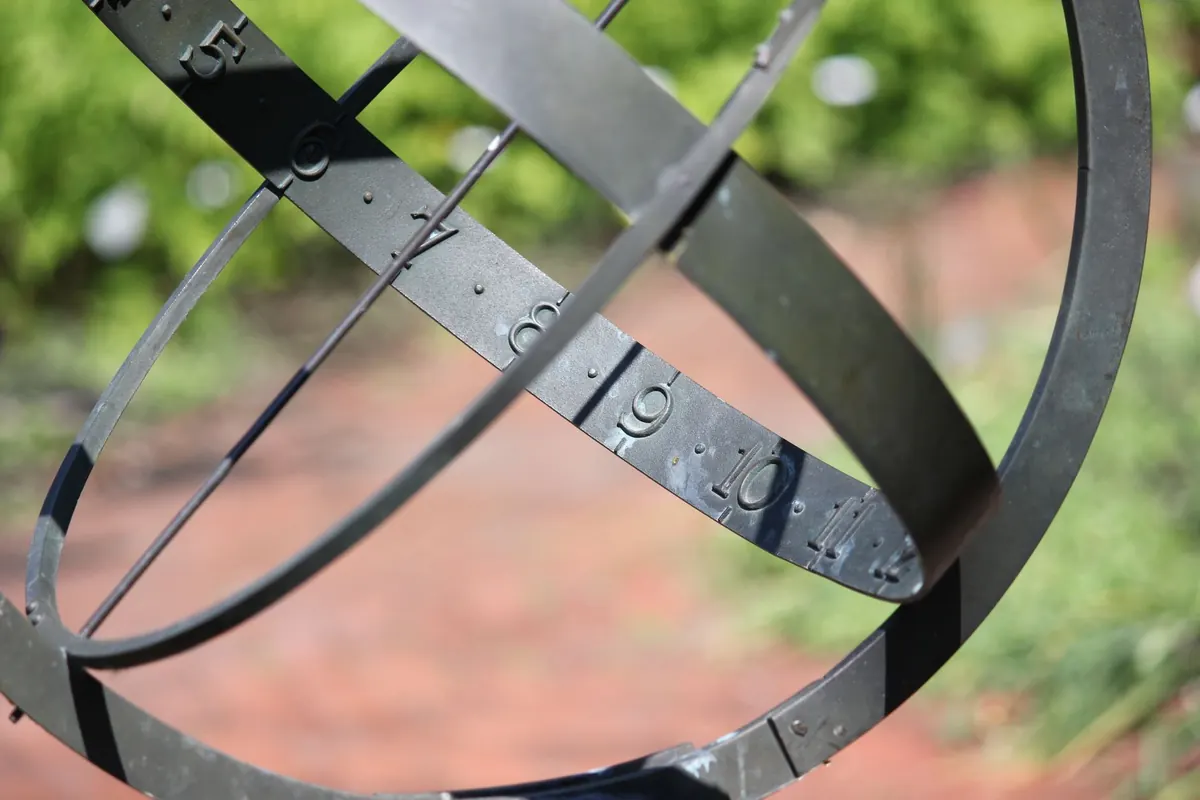


A sundial has no moving parts, which is exactly why people assume it will be right the moment it is bolted down. Then a clear noon arrives, the shadow lands fifteen minutes away from where the clock says it should be, and the doubts begin. Almost every dial that reads poorly is not badly made. It is badly sited, badly levelled, or pointed at the wrong north — and each of those is fixable in an afternoon with a spirit level, a plumb line and a little patience. What follows are the errors that turn up most often, roughly in the order they appear on a new installation, with the correction for each.
Magnetic north is not true north
A compass points at the magnetic pole, and for most of the world that is not where the true pole sits. The gap — magnetic declination — amounts to several degrees across much of Europe and North America, considerably more in some regions, and it drifts year by year as the field shifts. Line a dial up with a phone compass and you have built a small, permanent error into every reading.
How much damage that does depends on the dial. A rotation of two or three degrees about the vertical axis barely shows near noon and becomes obvious by mid-afternoon, because the error grows as the sun moves away from the meridian. That is precisely the behaviour that makes an owner suspect the dial itself rather than the installation.
The fix is to leave the compass in the drawer and use the sun. You will need a straight vertical rod, a clear day, and about half an hour.
- Push a length of dowel, a knitting needle or a plumb line into the ground or clamp it to the plinth exactly where the dial's centre will sit. It must be genuinely vertical.
- From late morning, mark the tip of its shadow every ten minutes on a sheet of paper or a paving slab.
- The shortest shadow marks solar noon, and its direction is true north in the northern hemisphere, true south in the southern.
- As a check, the marks either side of noon should be symmetrical about that line. If they are not, your marks were uneven or the rod moved.
- Fix the dial so its noon line lies along the meridian, sighting with a taut string rather than by eye.
If you must use a compass — say, on an overcast installation day — look up a current declination figure for your exact location from a national mapping or geological agency, apply it, and keep the instrument well away from steel railings, tools and car doors. Magnetic readings taken beside a parked car are worth nothing at all.
The plate is level in one direction only
A spirit level laid across a dial in a single direction tells you almost nothing. Horizontal dials have to be level in every direction and, just as importantly, flat. Garden dials are frequently bolted to a plinth that has settled on one side, or to a timber base that swells after autumn rain and lifts a corner by a couple of millimetres. A cheap cast plate may itself be slightly crowned from the foundry.
A tilt does not shift every reading by the same amount — it distorts the whole pattern of the day. That is why a leaning dial can look respectable at noon and hopeless at four o'clock, and why owners often blame the engraving. Correct it in this order:
- Check across the plate in two directions at right angles, then along both diagonals if the plate is square or round.
- Shim low corners with thin stainless washers or a sliver of lead flashing. Do not simply tighten the opposite screw; that bends the plate and makes the problem permanent.
- Check the style as well. A gnomon knocked a few degrees sideways by a broom, a football or a leaning ladder is one of the commonest faults on older garden dials, and it is invisible unless you crouch down and look along the edge.
The gnomon is set for someone else's latitude
On a horizontal dial, the angle between the sloping style and the plate must equal your latitude. Many ornamental dials are cast at a fixed angle chosen for a factory's home market, so a dial bought cheaply at a garden centre may be built for a latitude hundreds of kilometres from yours. The result is a dial that is passable at the equinoxes and increasingly wrong towards midsummer and midwinter.
If the style angle is wrong, be honest about the remedy. Shimming the base to compensate simply converts a horizontal dial into an inclined one, and the hour lines no longer match the plate they are engraved on. The proper fixes are a new style cut to the correct angle, or a new dial.
Read the edge, not the middle
The time is indicated by the shadow of the style's thin working edge, not by the centre of the dark band it throws. On a slender rod the difference is negligible; on a chunky cast gnomon twenty millimetres wide it can amount to several minutes, and rather more in the early morning and late evening when the shadow stretches and softens. Teach anyone who uses the dial to read the leading edge consistently, whichever side of noon it happens to be.
Comparing the dial with the clock without the corrections
This is less an alignment fault than an expectation fault, but it causes more disappointment than any other. A sundial shows local apparent time at its own longitude. A wristwatch shows civil time for a whole time zone, adjusted for daylight saving. Between the two sit three corrections, and none of them indicates that your dial is wrong.
The first is longitude: allow four minutes for every degree between your site and the standard meridian of your time zone, adding or subtracting according to which side you are on. The second is the equation of time, the difference between apparent solar time and mean time, which swings by roughly a quarter of an hour either way over the year and peaks in early November and mid-February. The third is daylight saving, a flat hour for part of the year.
Do not try to fix this by rotating the plate to match your watch. Keep a small conversion card beside the dial instead, or engrave a table of monthly corrections on the base. A dial honest about being a dial is far more satisfying than one quietly fudged to agree with a phone.
The site fights the dial
A dial needs an unobstructed horizon for the hours it is meant to show, and the obstruction test has to be done in the season that matters. A deciduous tree that is harmless in April will throw the whole afternoon into shade by September, and a neighbour's extension built after the dial went in can quietly kill its best hours. Watch the spot at the hours you care about in midwinter as well as midsummer; the sun's arc is much lower then, and low sun is easily blocked by walls, hedges and the dial's own pedestal.
Wall-mounted dials have an extra trap. A wall described as south-facing is rarely within a degree or two of true south, and a vertical dial engraved for a due-south wall will read wrongly on one that declines fifteen degrees
Photo: orko46 / Pixabay