
A sundial earns its place in a garden slowly. At first it reads as sculpture, a dark circle on a pedestal at the end of a path. Then one afternoon you glance at it, then at your watch, and the difference is four minutes. That is the moment the object becomes a small piece of working astronomy sitting in your borders, and it changes how you walk past it. Getting to that moment is mostly a matter of choosing carefully before you buy: the right material for your climate, a size that suits the space, and a position where the sun can reach it.
Begin With the Garden's Own Voice
A dial that looks wonderful in a walled Italian garden can look fussy in a wildflower meadow, and a rustic one can look apologetic outside a clipped box parterre. Before comparing models, decide which of these three descriptions fits your garden.
Formal gardens
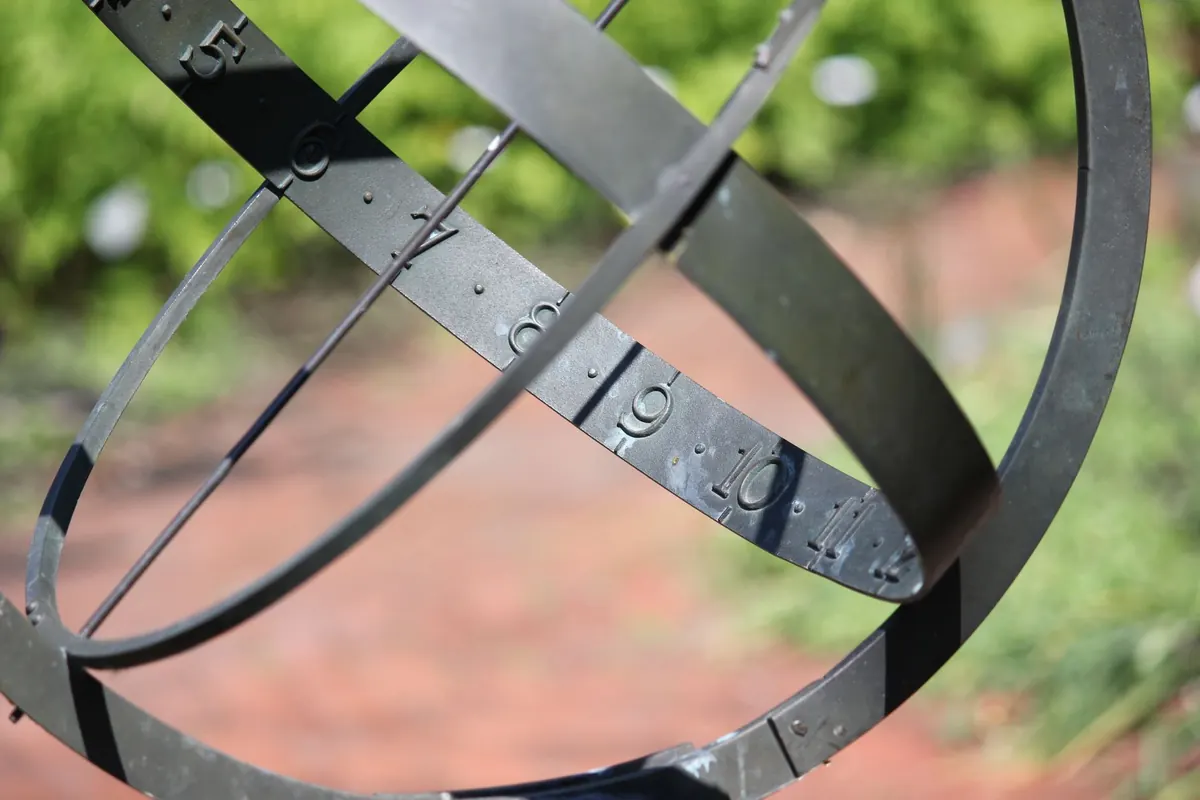
Symmetry and axis are the organising ideas here, so the dial should sit on one. Place it at the end of a main path, at the crossing of two, or centred on the view from a terrace door. A pedestal dial with a crisp, architectural base works better than anything rustic; armillary spheres and ring dials also suit this setting. Keep the pedestal plain and let the dial plate carry the detail. Roman numerals, a motto, a signed plate — formal gardens can take all of it.
Cottage gardens
Cottage style tolerates imperfection, and the dial should look as though it has been there a while. Weathered brass, painted iron with a little rust at the joints, a stone base half-swallowed by lady's mantle. Position matters less than atmosphere: a low pedestal tucked among perennials, a dial set into a gravel path, a small horizontal dial on a stone wall. Avoid anything too polished or too large, which will read as a garden centre ornament rather than a resident.
Modern gardens
Clean geometry, restrained materials, few objects. A horizontal dial with a simple plate and a single triangular gnomon in matte dark steel or pale concrete will hold its own against rendered walls and rectangular paving. Lines and dots often look better than numerals here. Consider a wall-mounted dial or a dial set flush into paving, which keeps the composition horizontal and uncluttered. One dial, well placed, is enough.
Materials and What They Become Over Time
Every dial material changes. Decide which change you want to watch, because you will be watching it for twenty years.
Cast stone and concrete
Heavy, stable, and excellent at damping vibration, which matters for accuracy. Cast stone takes crisp moulding and ages gracefully in most climates. In cold, wet places check that the mix is frost-resistant and that water cannot sit in a recessed bowl or on a flat plate where it will freeze and flake the surface.
Bronze and brass
The finest engraving and the most beautiful long-term behaviour. Brass starts golden and turns brown, then gradually to a soft green in exposed positions; bronze follows a similar path. If you want the green, leave it alone. If you prefer the metal bright, you will need to polish it a few times a year, which is a commitment rather than a chore.
Iron, steel, and stainless
Painted cast iron suits cottage and period gardens and rewards an occasional wire-brush and repaint. Mild steel will rust — fine for a deliberately weathered look, less fine near white render. Stainless steel resists everything but can look cold; a brushed finish softens it.
Scale, Proportion, and the Ten-Pace Test
The dial plate is the part that must be read, so size it for the distance from which people will actually look at it. A small courtyard dial of 25–30 cm across is legible from a few steps away. A dial at the far end of a long border or across a lawn needs 40 cm or more, or the numerals will dissolve into a grey blur.
Pedestal height is a separate decision. Somewhere between waist and chest height (roughly 90 cm to 1.1 m to the top of the plate) lets adults read the dial standing up, and children can still see it. Higher pedestals look grander but belong to gardens with long approaches, where the dial is a destination rather than a passing detail. If in doubt, set the pedestal in place temporarily and step back ten paces. If you cannot read the hour, it is too small or too far.
Setting the Gnomon: The Step Most Buyers Skip
A sundial is not decoration that happens to have a blade on it. The blade — the gnomon — must be angled to your latitude and aimed at true north (in the northern hemisphere). Most quality dials are made for a stated latitude; order accordingly or ask for an adjustable gnomon.
- Find true north, not magnetic north. Magnetic compasses point somewhere else, and the error varies by region. The reliable method is to mark the shortest shadow of a vertical stick around midday; that shadow lies along the true north–south line.
- Set the gnomon angle to your latitude. In Italy this runs from roughly 42 degrees in the south to about 46 in the north. A dial set for Palermo will drift noticeably in Turin.
- Level the pedestal. A dial out of level will be out of time, and permanently so.
- Align and fix. Rotate the dial until the noon mark agrees with your shadow line, then bolt or bed it down so nothing shifts.
- Expect small discrepancies. The sun runs ahead of or behind clock time by up to about a quarter of an hour across the year, and daylight saving adds an hour. A dial with an equation-of-time table engraved on it will explain this; if yours has none, a small note in a drawer is enough.
Placement, Light, and a Few Practical Details
Choose a spot with uninterrupted sun from mid-morning to late afternoon. Check for shadows that will fall on the plate at the hours you care about: a south wall, a mature tree, a hedge that will grow another metre. Frost can lift a light pedestal, so give it a proper footing below the frost line, or bed it on a compacted gravel base. Keep it out of the line of the mower and clear of the route children take across the lawn at speed. If the dial is valuable or the site is exposed to passers-by, either make it heavy enough to be awkward or anchor it.
Living With Patina
Resist the urge to keep a garden dial looking new. A slight lean of moss at the base, a green bloom on the brass, a softened edge on the stone — these are the signs of an object that belongs where it stands. Wipe the plate once a year with a soft cloth and water, check the fixings, and confirm the gnomon still points true. Nothing else is required.
Before You Buy: A Short Checklist
- Style agreed: formal, cottage, or modern — and the dial matches it.
- Dial diameter sized to the viewing distance, tested at ten paces.
- Gnomon made for your latitude, or adjustable.
- Material suited to your winters and your appetite for maintenance.
- Clear southern exposure for the hours you want to read.
- Pedestal height comfortable for the people who will use it.
- Footing and fixing planned before delivery, not after.
Buy for the garden you have, set it properly, and the dial will do the rest of the work itself — quietly, every sunny hour, for as long as you leave it there.
Photo: Tracy Elford / Pexels