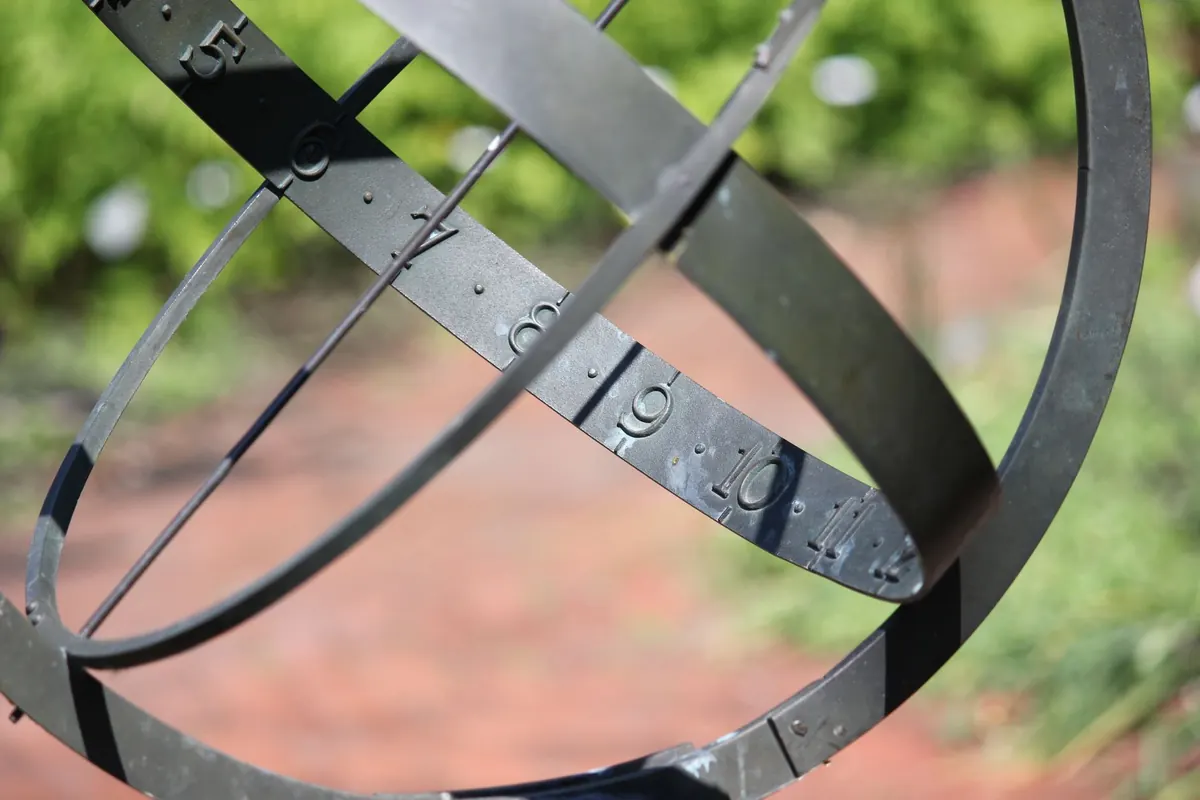


Every sundial is a small piece of astronomy left out in the weather. Between the lichen that creeps across a stone pedestal in a wet winter and the grit that settles into engraved numerals by June, an instrument that tells time so quietly is also being worn down by the same sky it reads. The good news is that a sundial asks for very little: perhaps two focused sessions a year, one in the first mild days of spring and one in the last dry days before winter settles in. Get those two right and the dial will outlast most of the garden around it.
Spring Starts With a Slow Walk-Around
Before you touch a cloth to the dial, spend ten unhurried minutes just looking. Spring is when winter's damage becomes visible — frost heave under a pedestal, a hairline crack that has opened a little wider, a gnomon that no longer sits quite square. Catching these now, while the ground is still soft and the days are mild, is far easier than discovering them in July when the dial has drifted out of alignment.
What to check before you clean anything
- Level and lean: rest a spirit level on the dial plate in two directions. A pedestal that has tilted even slightly will throw the hour lines off, especially near noon.
- Loose joints: grip the gnomon gently and test for movement where it meets the plate. Any wobble means water is getting into the joint.
- Surface changes: look for white bloom on bronze, blistering paint, dark streaks on limestone, or rust bleeding from iron fixings.
- The footing: check for gaps where the pedestal meets paving or soil, and for soil that has settled or been pushed up by frost.
- Debris: leaves, twigs, bird droppings, moss in the engraving, and grit trapped along the shadow edge of the gnomon.
Note what you find before you start cleaning. A photograph taken in flat morning light is enough, and it gives you something to compare against next year.
Cleaning the Dial Plate Without Doing Harm
Most of the dirt on a sundial is loose and comes away with water and patience. Start with a soft brush — a clean paintbrush or a wide, soft household brush — and lift off dry material first. Working dry keeps grit from turning into a grinding paste against the surface.
For the wash, use lukewarm water with a few drops of mild soap. Apply it with a soft cloth or sponge, working in small areas rather than flooding the whole plate. Engraved numerals and hour lines collect a surprising amount of compacted dirt; a soft-bristled toothbrush coaxed along the grooves, without pressure, does the job. Rinse with clean water and dry immediately with a soft, lint-free cloth. On stone or marble, blot rather than scrub at the end so water does not sit in the engraving.
A few things to avoid, consistently:
- Abrasive powders, scouring pads, and wire brushes, which scratch soft metals and blur fine engraving.
- Acidic cleaners, vinegar, and descalers on limestone, marble, or concrete. They etch the surface and leave a dull patch that never quite evens out.
- Pressure washers. They drive water into joints, lift paint, and can pit bronze.
- Aggressive polishing of a bronze dial. The green-brown patina is stable and protective; stripping it back to bright metal invites fresh corrosion.
Once the dial is dry, a thin coat of microcrystalline wax on bronze or brass — buffed out so no residue sits in the engraving — slows oxidation through the summer. Do not wax painted or gilded surfaces, and never wax a dial face where the wax would trap dust against the markings.
Checking the Gnomon and the Reading Line
The gnomon is the part that does the work, so it deserves the closest look. It should be straight, firmly fixed, and angled to match your latitude, pointing toward the celestial pole. Do not bend it to "correct" a reading; a bent gnomon distorts the shadow line all day.
Test alignment on a clear day around solar noon, when the shadow is shortest. Mark the shadow's edge on the noon line, then check it again a week later. If the shadow consistently falls to one side of the noon mark, the dial has rotated and needs resetting rather than adjusting. Portable dials on a garden table are especially prone to this — a nudge from a broom is enough. Set them back with a compass corrected for local magnetic variation, or simply by the noon-shadow method on a sunny day.
If the gnomon is fixed with a threaded rod or a collar, clean the threads and add a small amount of weather-resistant grease before reassembling. Tighten hand-firm, not hard: brass and bronze threads are softer than they look.
The Base, the Pedestal, and the Ground Beneath
Most sundial problems start below the plate. Frost heave lifts and tilts pedestals, and a pedestal that has moved by a couple of millimetres can shift the reading by several minutes. After the last frost, check whether the base is sitting flat and whether any mortar joints have opened. Rake back soil that has crept up against the pedestal — constant damp at the base is what feeds moss and spalling.
Plants are a mixed blessing here. A little foliage at the foot of a dial looks right, but heavy ground cover keeps the stone damp, and tall perennials can shade the plate at exactly the hours you want to read. Trim anything that throws a shadow across the dial between mid-morning and mid-afternoon, and keep mulch a hand's width away from the stone.
Winter Protection: Before the First Hard Frost
Winter damage is rarely dramatic. It is water getting into a joint, freezing, and quietly widening it; it is salt spray from a path landing on limestone; it is a heavy snowfall pressing on a gnomon. A short list in late autumn prevents most of it.
- Clean first. Dirt holds moisture against the surface all winter. Do a full clean and dry before covering anything.
- Bring in what can be moved. Small garden dials, armillary spheres, and table models belong indoors, in a dry shed or garage. Note the exact position and orientation before you lift them so spring realignment is quick.
- Wax metal parts. A thin coat on bronze and brass before winter adds a useful barrier.
- Cover, but let it breathe. Use a breathable cover — canvas, a vented fitted cover, or a simple wooden cap over the plate. Plastic sheeting wrapped tight traps condensation and does more harm than leaving the dial exposed.
- Clear snow gently. Use a soft brush or a wooden scraper, never a metal shovel, and never chip at ice on the dial face.
- Keep de-icing salt away. Salt damages stone, concrete, and unprotected metal. Redirect runoff from treated paths and steps.
If the dial is permanently fixed and cannot be covered neatly, do nothing rather than something clever. A well-made bronze or stone dial left alone will come through winter better than one wrapped in a sealed bag that holds condensation against the metal for four months.
A Short Seasonal Routine That Actually Gets Done
Spring: inspect, clean, wax, check alignment, tidy the planting. Midsummer: a five-minute check for bird droppings and cobwebs, and a glance at the gnomon after any storm. Autumn: full clean and dry, wax, cover or store, clear the base of leaves. That is the whole programme. Put it in a calendar with the other garden jobs and it stops being a decision.
One sensible caution: if your dial is old, signed, or made of marble, gilded brass, or painted iron, treat cleaning as conservation rather than housework. Test any product on a hidden area first, and if a surface is flaking, a joint is failing, or you are unsure what a metal actually is, stop and ask a conservator or a specialist restorer before you proceed. A sundial that has survived a century of weather deserves better than an afternoon of enthusiastic scrubbing.