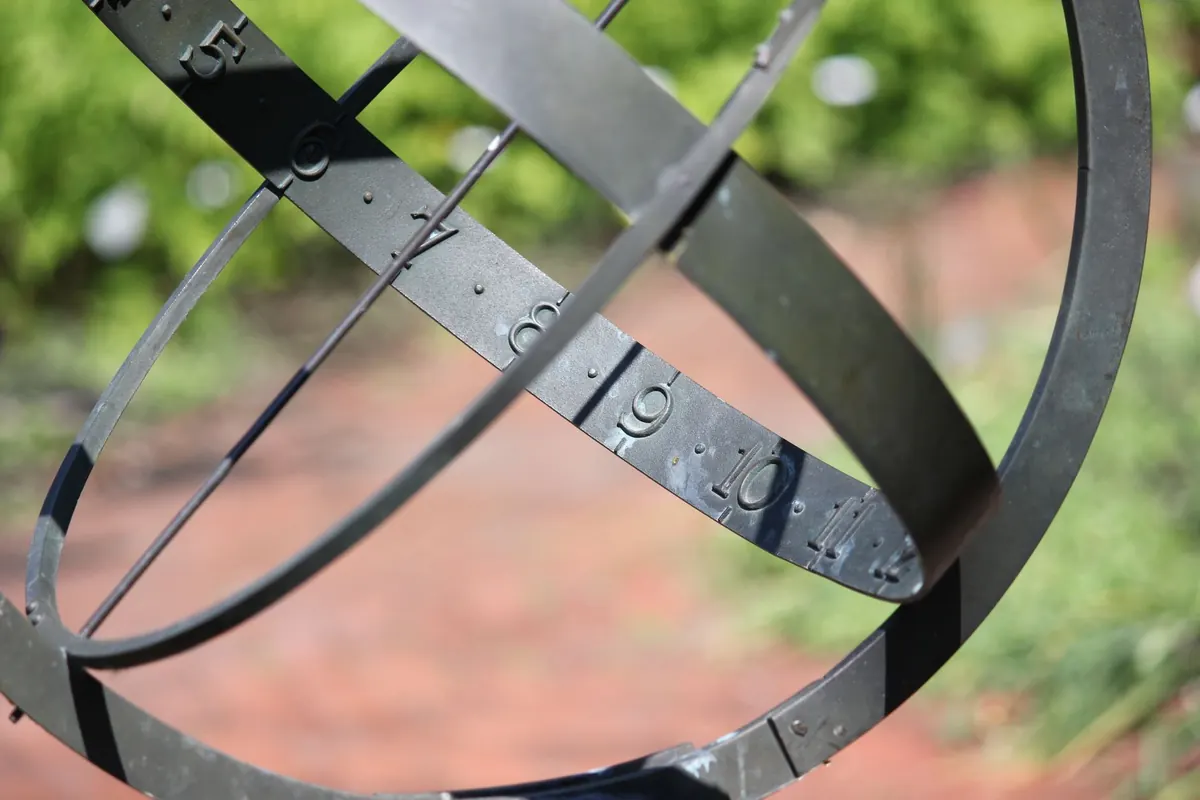

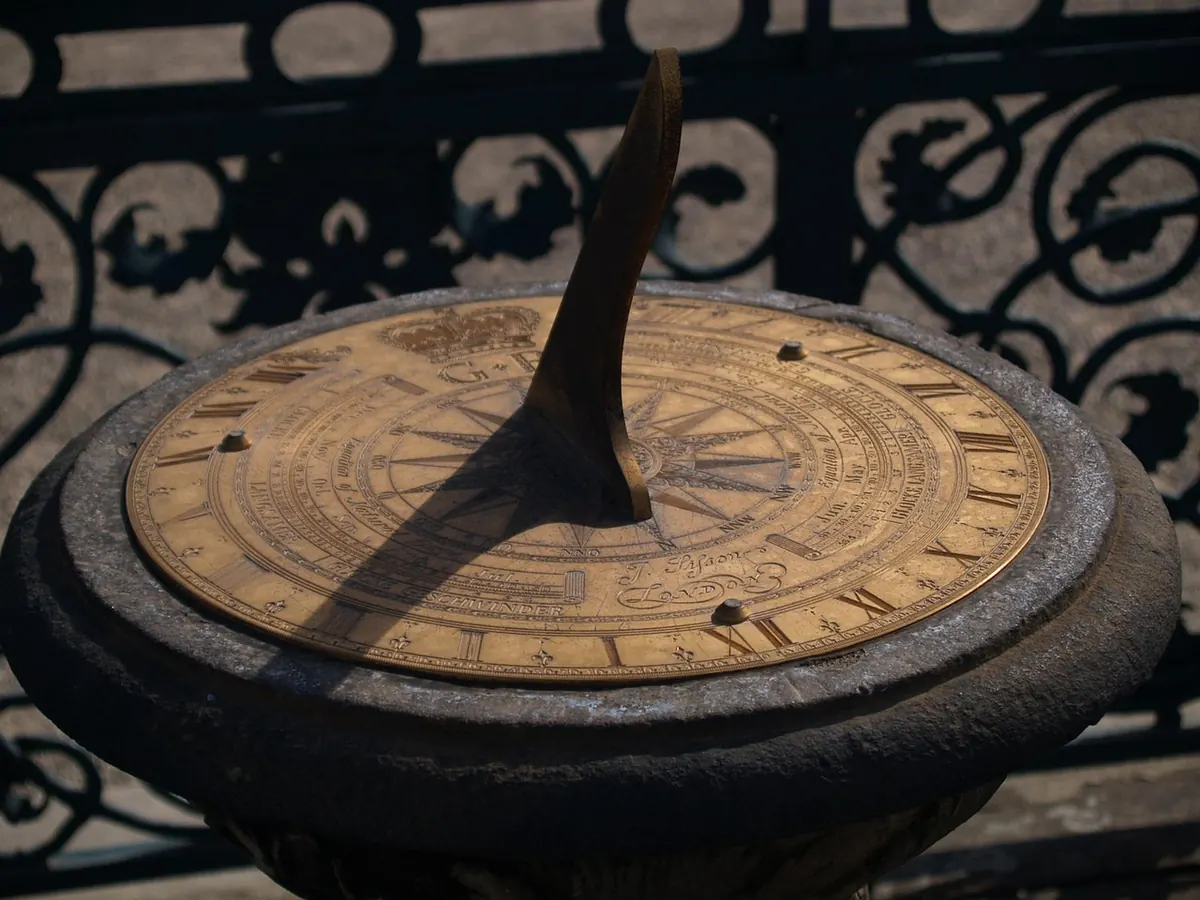
You check the sundial at what your phone calls noon and find it disagreeing—sometimes by a few minutes, sometimes by more than half an hour. The dial is not broken, and the phone is not lying. They are measuring different kinds of time. A sundial tracks the sun as it actually moves across your sky. A clock tracks a tidy average, bent to fit time zones and, for part of the year, daylight saving. Once you know the three corrections that separate them, a sundial becomes a precise instrument rather than a charming ornament.
Your sundial is not a clock
A sundial reports apparent solar time, also called true solar time. Noon on the dial is the moment the sun crosses your local meridian—the imaginary line that runs from due north to due south through your position. At that instant, the shadow is shortest or points along the noon line, depending on the dial's design. Morning and afternoon are measured from that single, local event.
Clock time is mean solar time adjusted to a standard meridian. It imagines a sun that moves at a perfectly steady pace all year, then applies the same time to a whole region. That is why clock noon can occur when the real sun is still climbing, already past its highest point, or exactly on the meridian.
Three different noons
It helps to keep three ideas separate: true solar noon (the sun on your meridian), mean solar noon (the average sun on your meridian), and clock noon (mean solar noon at the zone's standard meridian, plus any daylight-saving offset). A sundial reads the first. Your watch shows the third. The gap between them comes from the sun's seasonal irregularity, your distance from the standard meridian, and the extra hour of summer time.
A sundial is not wrong. It is answering a different question.
The equation of time: the sun's seasonal wobble
Earth's orbit is slightly elliptical, and its axis is tilted. Those two facts make the real sun run fast or slow compared with the imaginary average sun. The difference is called the equation of time. It is not an equation you solve; it is a correction curve that repeats every year.
Astronomers usually define it as apparent solar time minus mean solar time. When the value is positive, the sundial is ahead of mean solar time. When it is negative, the dial is behind. The extremes are modest but noticeable:
- In early November, the dial can run about 16 minutes ahead of mean solar time.
- In mid-February, it can run about 14 minutes behind.
- Around mid-April, mid-June, early September, and late December, the correction is close to zero.
So a dial that reads 12:16 in early November is not fast. It is showing apparent solar time while the mean sun is still at 12:00. To convert the dial reading to local mean solar time, subtract the equation-of-time value when the dial is ahead; add it when the dial is behind. A printed table, an almanac, or a reliable astronomy app will give you the value for the date.
Longitude: why your postcode changes noon
Earth turns 15 degrees every hour, which means one degree of longitude equals four minutes of time. Standard time zones are built around a central meridian, usually a multiple of 15 degrees: 0° for GMT, 15° east for Central European Time, 75° west for Eastern Standard Time. If you live on that meridian, mean solar noon and standard noon coincide—ignoring the equation of time and daylight saving. If you live east or west of it, they do not.
Take Rome, at roughly 12.5° east. Central European Time uses 15° east. Rome is 2.5 degrees west of the zone's standard meridian. Multiply by four minutes: ten minutes. The mean sun reaches Rome's meridian about ten minutes after it reaches 15° east, so mean solar noon in Rome falls near 12:10 CET, not 12:00. A place ten degrees west of its standard meridian would have solar noon about 40 minutes later on the clock. East of the meridian, the opposite happens: solar noon arrives earlier.
The arithmetic is simple: (your longitude − standard meridian) × 4 minutes. Treat east as positive and west as negative. The result is the difference between local mean solar time and standard time. If it is negative, local mean time is behind standard time, and solar noon comes later on the clock. If it is positive, local mean time is ahead, and solar noon comes earlier.
Daylight saving: the clock's extra hour
Daylight saving is the easiest correction to forget because it is not astronomical. The dial has no mechanism for it. When clocks move forward by an hour, the sun keeps crossing your meridian at the same solar time, but the clock now calls that moment one hour later. If mean solar noon would be 12:08 standard time, the summer clock reads 13:08.
Handle it as a separate step. Convert the dial reading to standard time first, then add the daylight-saving offset if it is in force. Do not move the gnomon or twist the dial to compensate. The dial is still aligned with the sun; the clock has simply changed its label. Dates and rules vary by country, so check the local schedule rather than assuming a fixed season.
Putting the corrections together
Here is a reliable routine for turning a dial reading into clock time. Work in minutes, and keep the signs straight.
- Read the dial. That is apparent solar time.
- Apply the equation of time. Subtract its value if the dial is ahead; add it if the dial is behind. You now have local mean solar time.
- Apply longitude. Subtract (your longitude − standard meridian) × 4 minutes. You now have standard time.
- Apply daylight saving. Add the offset in force—usually one hour—if summer time is being observed.
Suppose the dial reads 12:16 on a day when the equation of time is +16 minutes. Subtract 16 minutes to get 12:00 local mean solar time. In Rome, 2.5 degrees west of the 15° east meridian, the longitude step is −10 minutes; subtracting −10 adds 10, giving 12:10 standard time. In early November there is no daylight saving, so the clock should read 12:10. The dial is six minutes ahead of the clock—not because it is faulty, but because the sun is ahead of mean time and Rome is west of its zone meridian.
If you prefer to go the other way, from clock to dial, reverse the steps: remove daylight saving, add the longitude difference, then add the equation of time. The same numbers work in both directions as long as you keep the signs consistent.
A practical check for your own dial
Before you blame the sun, check the basics. The dial should be level, and the gnomon—the edge that casts the shadow—should point to true north in the northern hemisphere or true south in the southern hemisphere, not magnetic north. A small twist or tilt can cost several minutes, especially on a large dial. Many garden dials are also designed for a particular latitude; if yours has been moved a long way from its original home, its readings may be off in a way that no time correction can fix.
Then choose a clear day, note the clock time and the dial time at the same moment, and write down the difference. Repeat once a month for a year if you can. You will see the gap widen and shrink with the equation of time, jump by an hour when daylight saving begins or ends, and settle into a steady offset that reflects your longitude. That notebook is more useful than any single conversion: it teaches you your dial's habits. Once you know them, you can glance at the shadow and translate it in your head—no app required, just a little patience and the sun's own schedule.